Gilbert told me that at this point, the three characters for the playthrough would be set, and players couldn't turn back.
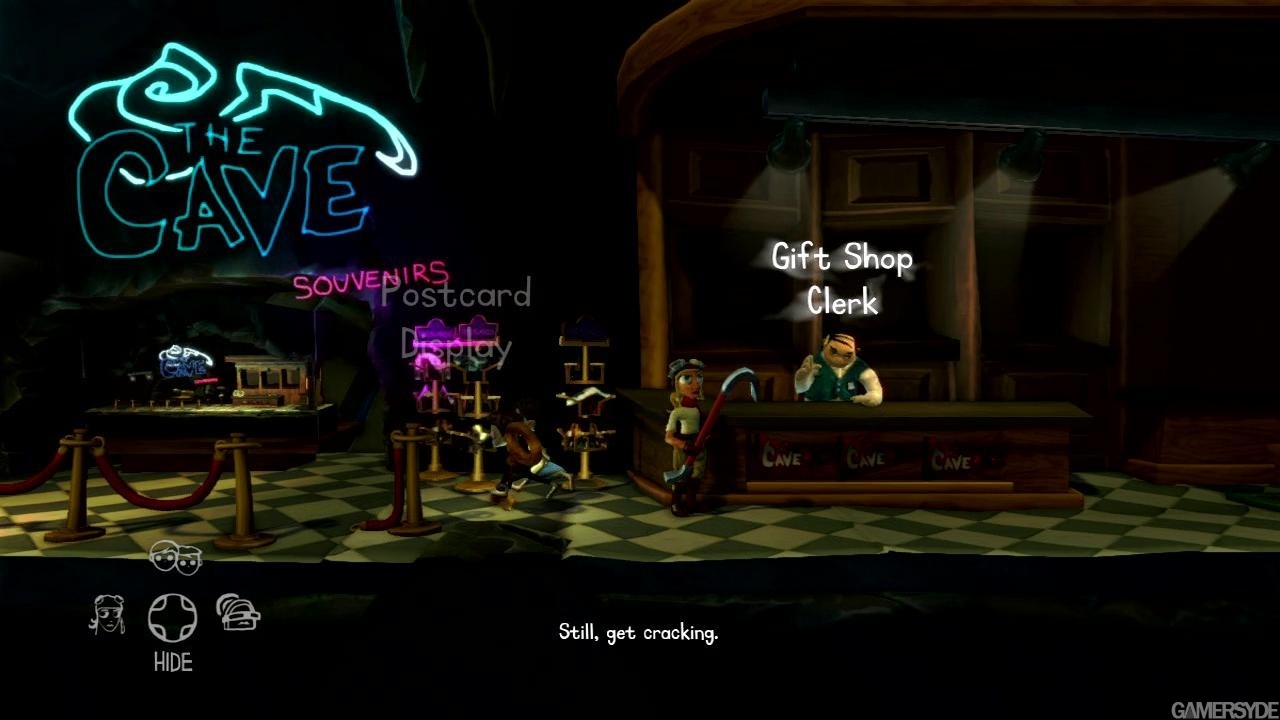
I was expecting to find another puzzle, but I wasn't expecting to find another speaking character—and yet, as I climbed my adventurer out of the water, that's just what I found. I heard a man crying. I came out into a large, gaudy "THE CAVE" gift-shop. Something about it felt, well, entirely appropriate for this kind of game. "I hope you're not here to visit the Cave," a ruddy man behind the counter said through tears, "because.. we're closed!" There had been a horrific accident, and they were forced to close. What was the disaster? Oh, they had "no trinkets to sell."
Guess what? I had to go get some trinkets.
I then had to bypass a gate that forced me to use the three-character setup: First, two characters had to pull a lever at the same time—after I'd pull it, I'd switch to another character, and the character I'd been using would keep pulling the lever. It was a good warm-up for what will doubtless be the game's defining mechanic.
With that, I was off to the left and face to face with the monster-bypass puzzle I'd seen in a demo back when the game was unveiled.
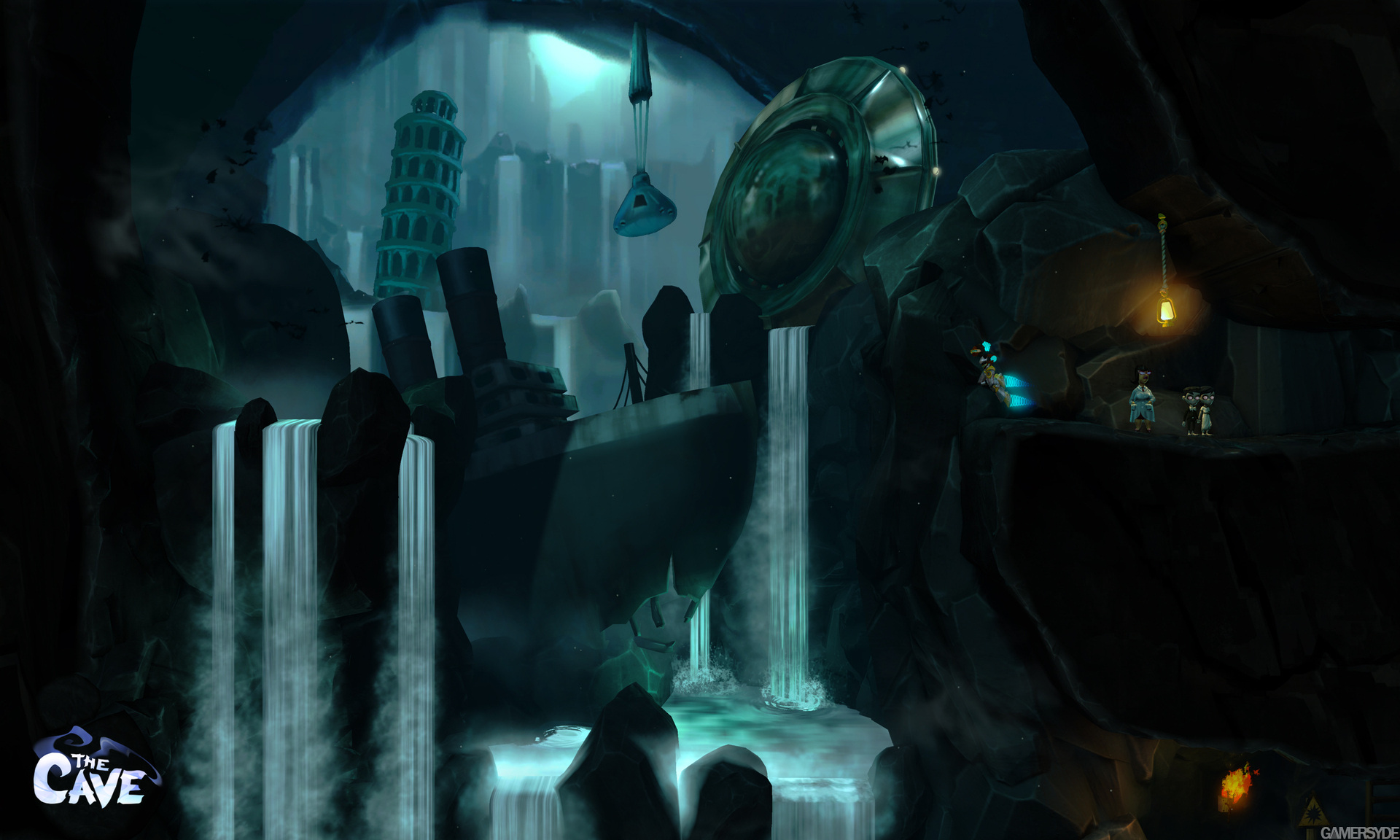
The setup was classic adventure game: There's a monster, and if you try to get around him, he'll kill you instantly. There's a huge crane-claw located above him, and clearly you have to lure him underneath the claw and catch him in it to proceed.
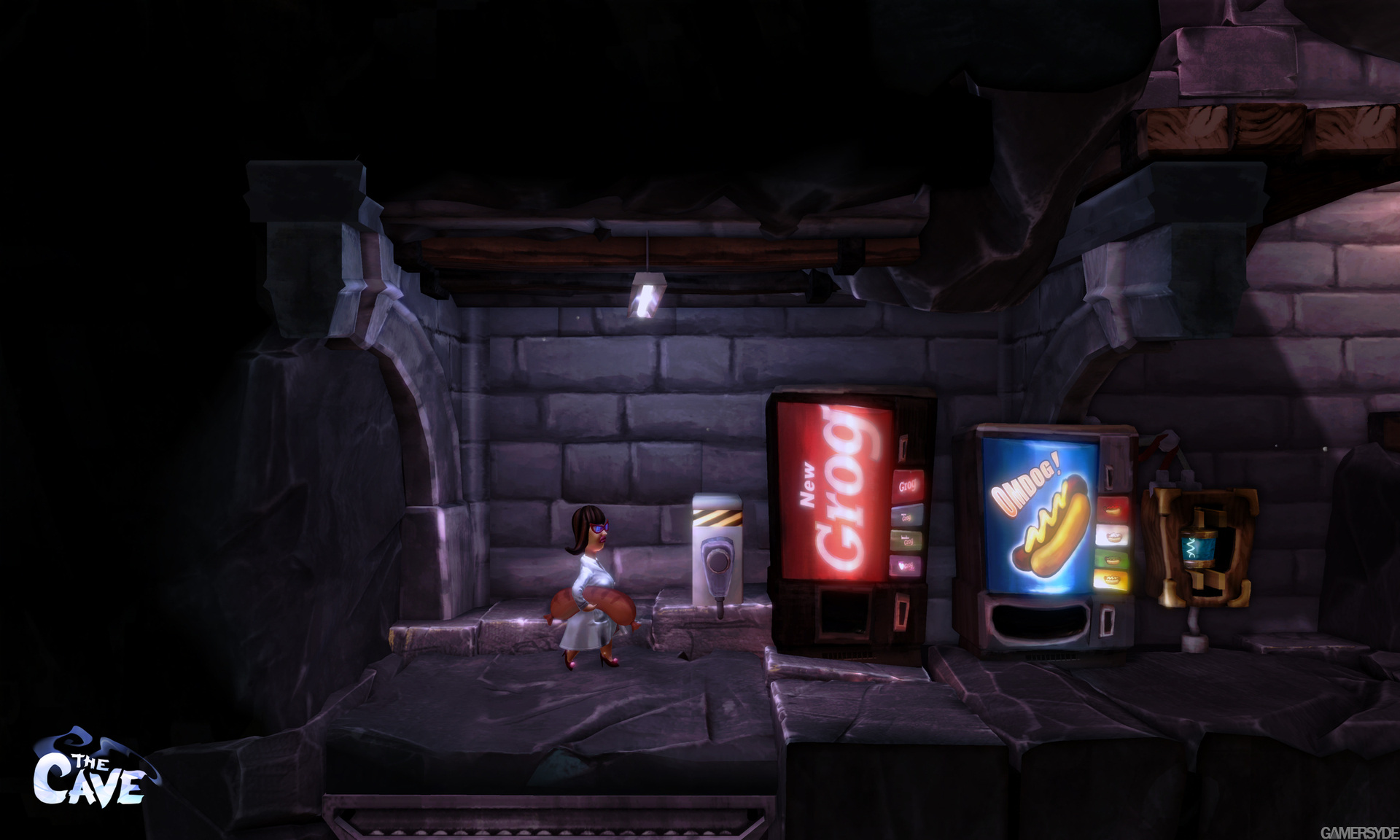
I had: A sparking fusebox that killed me when I touched it, two wells, a pit in front of a monster, a broken-down crane, and a vending machine with no power. Sound adventure-gamey enough for you?
The eventual solution was simple enough, but after I poked and prodded at it for a while, Gilbert walked me through it in the interest of time. (Or at least, that's what I'm telling myself).
"I like when people are stuck and confused, I find that more fascinating than frustrating," Gilbert said.
Here's the solution: Take a bucket from the well, put it over the water to stop the fusebox from shorting out, take the fuse down to the other fusebox next to the vending machines, plug it in, buy a hot dog, carry the fuse back up to next to the crane, plug it in, get the crane set, and then—I'm ready.
Now here's the thing—two things made this all more interesting than standard adventure game fare: One, I had more direct control of the characters—I could run and jump with them, which simply makes the game a bit more involving than pointing and clicking. Second, a lot of the puzzles required hopping between my characters in mid-action.
Once the claw was powered up, I had my adventurer toss the hot dog out into the pit. When the monster came running out to eat it, I hopped up to my monk, who was standing up at the crane's controls, and had him drop the claw. It snagged the monster, and I was free to go on my way.
I was struck by how complex this first puzzle was—I asked if the game would feature a lot of these more involved puzzles, and designer JP LeBreton confirmed that yep, it would. Some of the character-specific regions, he said, would feature several of them at the same time, and players would be able to tackle them in whatever order they want, like the hubs in classic adventure games.
Since each character has a special ability—the adventurer has a grappling hook, the time-traveler can warp through walls, etc—there are multiple solutions to each puzzle. Gilbert told me that he wants the game to be about experimentation and discovery—as you play, you'll figure out things you can do with special abilities that you didn't think were possible.



 Ben eens benieuwd.

