Installeer de app
Hoe installeer je de app op iOS
Volg de onderstaande video om te zien hoe je onze site als web-app op je startscherm installeert.
Opmerking: Deze functie is mogelijk niet beschikbaar in sommige browsers.
Je gebruikt een verouderde webbrowser. Het kan mogelijk deze of andere websites niet correct weergeven.
Het is raadzaam om je webbrowser te upgraden of een browser zoals Microsoft Edge of Google Chrome te gebruiken.
Het is raadzaam om je webbrowser te upgraden of een browser zoals Microsoft Edge of Google Chrome te gebruiken.
Archief - Elektronisch roken Deel 2
Het archief is een bevroren moment uit een vorige versie van dit forum, met andere regels en andere bazen. Deze posts weerspiegelen op geen enkele manier onze huidige ideeën, waarden of wereldbeelden en zijn op sommige plaatsen gecensureerd wegens ontoelaatbaar. Veel zijn in een andere tijdsgeest gemaakt, al dan niet ironisch - zoals in het ironische subforum Off-Topic - en zouden op dit moment niet meer gepost (mogen) worden. Toch bieden we dit archief nog graag aan als informatiedatabank en naslagwerk. Lees er hier meer over of start een gesprek met anderen.

Hatchetman
Legacy Member
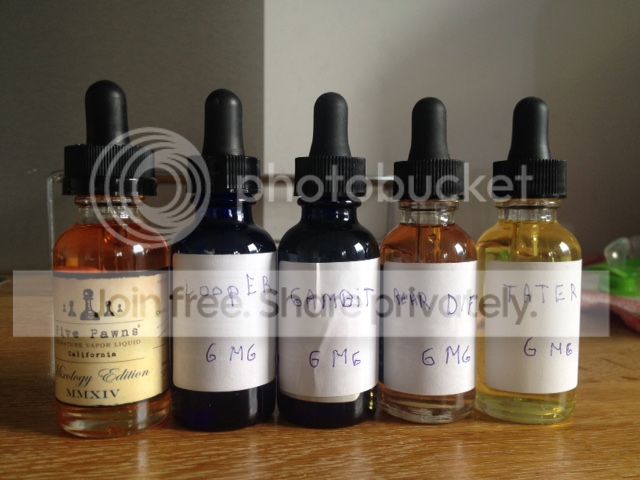
Is dat welgekende clone recept, de bourbonsmaak is wat anders dan de originele imho.
De rear diff kan wat kleine witte puntjes aan de top hebben, ben niet zeker hoe dat komt.
Heb al mijn liquids in oven gesteeped voor paar uur, met dopjes toe op lage temp en ik had het met alle 3 de flesjes van u, nostra en mijn met die smaak, andere smaakjes zelfde steep hadden dat niet.
Vraag me af of dat gekristalizeerde suiker is van die pumpkin pie flavor, alhoewel om te kristalizeren heb je toch echt wel erg hoge temp nodig?
De rear diff kan wat kleine witte puntjes aan de top hebben, ben niet zeker hoe dat komt.
Heb al mijn liquids in oven gesteeped voor paar uur, met dopjes toe op lage temp en ik had het met alle 3 de flesjes van u, nostra en mijn met die smaak, andere smaakjes zelfde steep hadden dat niet.
Vraag me af of dat gekristalizeerde suiker is van die pumpkin pie flavor, alhoewel om te kristalizeren heb je toch echt wel erg hoge temp nodig?
shakadeema be
Legacy Member
Flesjes van mij zouden normaal al vape klaar moeten zijn.
Behalve die crunchberry lemon kan je beter nog een dag of 3 laten staan.
Steepen in de oven doe ik niet, als er iets gesteeped moet worden neem ik een glas lauw water en zet ik het flesje daar in.
Dat witte randje aan top van het flesje heb ik ook als ik net iets vers gemaakt heb.
Gaat bij mij na een paar dagen weg.
Behalve die crunchberry lemon kan je beter nog een dag of 3 laten staan.
Steepen in de oven doe ik niet, als er iets gesteeped moet worden neem ik een glas lauw water en zet ik het flesje daar in.
Dat witte randje aan top van het flesje heb ik ook als ik net iets vers gemaakt heb.
Gaat bij mij na een paar dagen weg.
Hatchetman
Legacy Member
Inside FlavourArt
https://youtu.be/x01Sn7kUMdw
Staat nog niet op busardo zijn kanaal, geen idee waarom.
Informatieve post van John gisteren, één van de FA mensen op ukv ivm flavors.
https://youtu.be/x01Sn7kUMdw
Staat nog niet op busardo zijn kanaal, geen idee waarom.
Informatieve post van John gisteren, één van de FA mensen op ukv ivm flavors.
Over the past six years I have been lucky (sometimes unlucky!) to have tried hundreds of different flavours. One predominant trait seems to be that of over-flavouring eliquid; you often read of vapers using up to 30% flavouring in an eliquid, which seems crazy. UK and US vapers have a penchant for 'in your face' flavours that are strong to the point of overpowering. Go to Italy however and you will find the preference is more for subtlety and complexity. If blended flavours are overdosed they often lose the distinction between the key flavours and can be overtaken by the background flavours. The whole purpose of blending flavours is to create a mixture that has an overall pleasing taste; all of the key flavours should remain in the foreground with the space between them being filled more discreetly with the background flavours that are created during the blending and steeping process. If you painted a picture of five beautiful models on a white background it might look okay. If you added a busy background with lots of brightly coloured elements, the models might be lost or overpowered. If you painted a sympathetic background, say a nice blue sky, sea, sand,and a few palm trees carefully positioned, then you might have a good picture.
It is a similar principle when creating a blend of flavourings and the ultimate aim is to create something that people can savour and enjoy. It might be necessary to re-educate our tastes in order to experience the true complexity of some blends by using smaller amounts in our eliquid. This is something I have been trying for some time and I am once again enjoying vaping more without my taste buds being assaulted by intense flavours. There is so much pleasure in being able to hear each member of the flavour orchestra rather than just the bang of the drum, the strident notes of the horns, or the clash of symbals. Some will be more prominent but they should all blend together to create the perfect symphony with each note harmonised.
Try mixing some blended flavours at around 3% to 5% then fine tune your equipment to find the sweet spot and you could be nicely surprised, although it might take a while for your palate to adjust to the subtleness. Less can be more and with complex flavours that is often the case. Sometimes it will be necessary to vape at a lower power to find that sweet spot, sometimes it will require more airflow to find the perfect vape on a particular flavour; being able to 'shape the vape' by way of making minor adjustments is just as important as choosing where to sit when listening to the orchestra.
The “Taste Map”: All Wrong:-
One of the most dubious “facts”about taste—and one that is commonly reproduced in textbooks—is the oft-cited but misleading “tongue map” showing large regional differences in sensitivity across the human tongue. These maps indicate that sweetness is detected by taste buds on the tip of the tongue, sourness on the sides, bitterness at the back and saltiness along the edges. Taste researchers have known for many years that these tongue maps are wrong. The maps arose early in the 20th century as a result of a misinterpretation of research reported in the late 1800s, and they have been almost impossible to purge from the literature. In reality, all qualities of taste can be elicited from all the regions of the tongue that contain taste buds. At present, there is no evidence that any kind of spatial segregation of sensitivities contributes to the neural representation of taste quality, although there are some slight differences in sensitivity across the tongue and palate.
The Taste Mechanism:-
Flavour is a complex mixture of sensory input composed of taste (gustation), smell (olfaction) and the tactile sensation of food as it is being munched, a characteristic that food scientists often term “mouthfeel.”
Although people may use the word “taste” to mean “flavour,” in the strict sense it is applicable only to the sensations arising from specialized taste cells in the mouth. Scientists generally describe human taste perception in terms of four qualities: saltiness, sourness, sweetness and bitterness. Some have suggested, however, that other categories exist as well—most notably umami, the sensation elicited by glutamate, one of the 20 amino acids that make up the proteins in meat, fish and legumes. Glutamate also serves as a flavour enhancer in the form of the additive monosodium glutamate (MSG).
Taste cells lie within specialized structures called taste buds, which are situated predominantly on the tongue and soft palate. The majority of taste buds on the tongue are located within papillae, the tiny projections that give the tongue its velvety appearance. (The most numerous papillae on the tongue—the filiform, or threadlike, ones—lack taste buds, however, and are involved in tactile sensation.) Of those with taste buds, the fungiform (“mushroomlike”) papillae on the front part of the tongue are most noticeable; these contain one or more taste buds. The fungiform papillae appear as pinkish spots distributed around the edge of the tongue and are readily visible after taking a drink of milk or placing a drop of food colouring on the tip of the tongue.
SALTS, such as sodium chloride (NaCl), trigger taste cells when sodium ions (Na+) enter through ion channels on microvilli at the cell’s apical, or top, surface. The accumulation of sodium ions causes an electrochemical change called depolarization that results in calcium ions (Ca++) entering the cell. The calcium, in turn, prompts the cell to release chemical signals called neurotransmitters from packets known as vesicles. Nerve cells, or neurons, receive the message and convey a signal to the brain. Taste cells repolarize, or “reset,” themselves in part by opening potassium ion channels so that potassium ions (K+) can exit.
ACIDS taste sour because they generate hydrogen ions (H+) in solution. Those ions act on a taste cell in three ways: by directly entering the cell; by blocking potassium ion (K+) channels on the microvilli; and by binding to and opening channels on the microvilli that allow other positive ions to enter the cell. The resulting accumulation of positive charges depolarizes the cell and leads to neurotransmitter release.
SWEET STIMULI, such as sugar or artificial sweeteners, do not enter taste cells but trigger changes within the cells. They bind to receptors on a taste cell’s surface that are coupled to molecules named G-proteins. This prompts the subunits (a , b and g ) of the Gproteins to split into a and bg , which activate a nearby enzyme. The enzyme then converts a precursor within the cell into so-called second messengers that close potassium channels indirectly. Just as important as ingesting the appropriate nutrients, is not ingesting harmful substances.The universal avoidance of intensely bitter molecules shows a strong link between taste and disgust. Toxic compounds, such as strychnine and other common plant alkaloids, often have a strong bitter taste. In fact, many plants have evolved such compounds as a protective mechanism against foraging animals. The sour taste of spoiled foods also contributes to their avoidance. All animals, including humans, generally reject acids and bitter-tasting substances at all but the weakest concentrations. The intense reactions of pleasure and disgust evoked by sweet and bitter substances appear to be present at birth and to depend on neural connections within the lower brain stem.
The strong link between taste and pleasure—or perhaps displeasure—is the basis of the phenomenon of taste-aversion learning. Animals, including humans, will quickly learn to avoid a novel food if eating it causes,or is paired with,gastrointestinal distress.
About Flavors
We have the pleasure to inform you about flavors
Natural and artificial flavors are defined for the consumer in the Code of Federal Regulations. A key line from this definition is the following: " a natural flavor is the essential oil, oleoresin, essence or extractive, protein hydrolysate, distillate, or any product of roasting, heating or enzymolysis, which contains the flavoring constituents derived from a spice, fruit or fruit juice, vegetable or vegetable juice, edible yeast, herb, bark, bud, root, leaf or similar plant material, meat, seafood, poultry, eggs, dairy products, or fermentation products thereof, whose significant function in food is flavoring rather than nutritional." Synthetic flavors are those that are made from components that do not meet this definition.
The question at hand, however, appears to be less a matter of legal definition than the "real" or practical difference between these two types of flavorings.
There is little substantive difference in the chemical compositions of natural and artificial flavorings. They are both made in a laboratory by a trained professional, a "flavorist," who blends appropriate chemicals together in the right proportions. The flavorist uses "natural" chemicals to make natural flavorings and "synthetic" chemicals to make synthetic flavorings. The flavorist creating synthetic flavoring must use the same chemicals in his formulation as would be used to make a natural flavoring, however. otherwise, the flavoring will not have the desired flavor. The distinction in flavorings--natural versus artificial--comes from the source of these identical chemicals and may be likened to saying that an apple sold in a gas station is artificial and one sold from a fruit stand is natural.
This issue is somewhat confusing to the average consumer in part because of other seeming parallels in the world. One can, for example, make a blue dye out of blueberry extract or synthetic pigments. These dyes are very different in chemical composition yet both yield a blue color. Similarly, consider one shirt made from wool and another from nylon. Both are shirts, but they have very different chemical compositions. This diversity of building blocks is not possible in flavorings--one makes a given flavor only by using specific chemicals. Thus, if a consumer purchases an apple beverage that contains an artificial flavor, she will ingest the same primary chemicals that she would take in if she had chosen a naturally flavored apple beverage and the same chemicals that nature provided during the apple ripening.
When making a flavor, the flavorist always begins by going to the scientific literature and researching what chemicals nature uses to make the desired flavor. He then selects from the list of flavor components found in, say, real apples, generally simplifying nature list to eliminate those chemicals that make little contribution to taste or are not permitted owing to toxicity. (Nature has no restrictions on using toxic chemicals, whereas the flavorist does.) The flavorist then either chooses chemicals that are natural (isolated from nature as described above) or synthetic chemicals (made by people) to make the flavor.
So is there truly a difference between natural and artificial flavorings? Yes. Artificial flavorings are simpler in composition and potentially safer because only safety-tested components are utilized. Another difference between natural and artificial flavorings is cost. The search for "natural" sources of chemicals often requires that a manufacturer go to great lengths to obtain a given chemical. Natural coconut flavorings, for example, depend on a chemical called massoya lactone. Massoya lactone comes from the bark of the Massoya tree, which grows in Malaysia. Collecting this natural chemical kills the tree because harvesters must remove the bark and extract it to obtain the lactone. Furthermore, the process is costly. This pure natural chemical is identical to the version made in an organic chemists laboratory, yet it is much more expensive than the synthetic alternative. Consumers pay a lot for natural flavorings. But these are in fact no better in quality, nor are they safer, than their cost-effective artificial counterparts.
Propaganda
Legacy Member
Deze week bezig geweest met mijn eerste RDA;
Na een beetje spelen de scottish roll tegengekomen.
Beste vape ervaring tot nu toe!
Ben nu aan het denken om ook een RTA te kopen. Zijn die Kayfun's nog steeds de beste keus?
Na een beetje spelen de scottish roll tegengekomen.
Beste vape ervaring tot nu toe!
Ben nu aan het denken om ook een RTA te kopen. Zijn die Kayfun's nog steeds de beste keus?
Propaganda
Legacy Member
Nostradamus2000 zei:Fev powa. Is eigenlijk een auto dripper.

Vind er maar weinig reviews van (en ze zijn bijna allemaal in het duits
 )
)Is dat de v3?
Heb je de v4 al geprobeerd (zou eerder die kopen omdat die wel airflow control heeft)
Beter als de kayfuns?
Hatchetman
Legacy Member
Dominick ging later vandaag of morgen ook nog even laten weten wat hij juistbeter vindt, die heeft voor jaren kayfun lights en de nieuwe kayfun als main vapes gebruikt.
Sinds hij deze heeft gebruikt i niks anders meer volgens mij.
Crimmys juice shit hit the fan lol, zaten daar geen liefhebbers van hier.
http://www.timothyhoogland.com/2015...estionable-cleanliness-and-other-information/
Sinds hij deze heeft gebruikt i niks anders meer volgens mij.
Crimmys juice shit hit the fan lol, zaten daar geen liefhebbers van hier.
http://www.timothyhoogland.com/2015...estionable-cleanliness-and-other-information/
Nostradamus2000
Legacy Member
V4 bestaat nie. Is crapy clone. Heeft wel een db versievan 20 ml
Der original Flash e Vapor V3 Shop
Der original Flash e Vapor V3 Shop
Hatchetman
Legacy Member
Dominick kan blijkbaar niet meer op dit forum sinds de hack, moest je er nog wat aan hebben.
Een idee van mezelf nog, als ge persé iets wilt met kayfun deck zou ik een crown kopen + het rebuild deck apart bijkopen.
Kunt ge hem gebruiken met de erg goede stock coils op luie momenten en op de momenten datge wilt rebuilden hebt ge uw deck ervoor.
Dit is de tank met prebuild heads
https://youtu.be/0yPU5lm4baA
Dit is rebuild deck
https://youtu.be/v80iULYuO6w
Kayfun heeft voor mij persoonlijk alleen maar echt voordelen als je de vorige modellen hebt gehad.
Het bijvullen en coil veranderen gaat heel gemakkelijk toch wordt het na een tijd een sleur.
Heel het ding uitwassen en opnieuw coilen nam bij mij toch eek 15 min in beslag
Ook vind ik dat 90 procent van mijn juices niet de smaak gaven na 1-2 dagen
Daarin is de fev veel makkelijker op te zetten
Je zet hem op als een dripper en werkt als een dripper maar dan met een tank
De smaak blijft identiek zoals een dripper en daar ben ik heel enthousiast over
Heb hem nu al paar maanden en heb nog niks problemen gehad zoals droge hits of lekken
Dat doet de kayfun dan weer wel na een tijd
Ik damp ook perfect 100 procent vg juices in de fev 2
Had ik het geweten hoe goed de fev was had ik nooit de kayfuns gekocht.
Op 5 min is de fev 2 uitgekuisd opnieuw gecoild en gewicked
Moest je een filmke pf review willen zien
Er is een zekere Engels man Andrew en die heeft een review
Of gewoon de clone review opzoeken die zijn toch identiek
Een idee van mezelf nog, als ge persé iets wilt met kayfun deck zou ik een crown kopen + het rebuild deck apart bijkopen.
Kunt ge hem gebruiken met de erg goede stock coils op luie momenten en op de momenten datge wilt rebuilden hebt ge uw deck ervoor.
Dit is de tank met prebuild heads
https://youtu.be/0yPU5lm4baA
Dit is rebuild deck
https://youtu.be/v80iULYuO6w
.Steven.
Legacy Member
Ik begin da coils maken stillekesaan beu te worden vooraleer ik er goe en wel aan begonnen ben. Ik heb 0,5 kanthal liggen. Had nen tijd geleden ne Zephyrus ontvangen in ne vapebox dus dacht leuk, ook eens proberen coils maken. Heb een iStick 30W en kreeg niet anders dan atomizer short of low, weet niet meer juist. Van ellende da ding weg gedaan omdat ik dacht dat het aan die tank moest liggen. Nu heb ik sinds een weekske ne Goblin mini en ist weer van da.
Zijn er nog mensen die problemen hebben met coils maken subohm met ne iStick? Als ik 1ne coil maak gloeit die trouwens mooi, maar van zodra er ne tweede bijkomt ist gedaan met de fun. Ofwel werken ze dan allebei niet, oftewel af en toe ene wel. En uiteraard ook weer gepaard met de nodige meldingen. Ik heb er ondertussen mijne buik al van vol. Zo moeilijk kan dat toch niet zijn zou je denken.
Zijn er nog mensen die problemen hebben met coils maken subohm met ne iStick? Als ik 1ne coil maak gloeit die trouwens mooi, maar van zodra er ne tweede bijkomt ist gedaan met de fun. Ofwel werken ze dan allebei niet, oftewel af en toe ene wel. En uiteraard ook weer gepaard met de nodige meldingen. Ik heb er ondertussen mijne buik al van vol. Zo moeilijk kan dat toch niet zijn zou je denken.
Hatchetman
Legacy Member
Met dual coils gaat ge al rap erg laag in ohms zitten he? Tis dan ook nog een istick 30 watt
Istick is zo al van bedenkelijke kwaliteit om daar dan nog ff duals 0,5 kanthal op te knallen is mss wat teveel van het goede. Op een istick door uw shorts (wat de meeste zo niet alle contact coils sowieso hebben) uit pulsen etct lijkt me niet makkelijk, die dingen hebben dan ook een short protectie.
Als uw eerste coil mooi van binnen (midden) naar buiten gloeit moet ge uwe 2de coil bewerken met een nijptangetje of er eens over brushen tot ze alle 2 gelijk opgloeien, voor ze dat doen heeft het geen zin om daar wick door te trekken. Ge zult wss wel al filmpjes gezien hebben van hoe een coil te "brushen" of samenknijpen?
Gebruikt ge touching coils of open? De lengte (van beentjes) en windingen moeten naturlijk ook gelijk zijn zowat anders hebt ge altijd verschil.
imho zijn dual coils veel te veel miserie voor wat het is....zeker in een tank, op een dripper kan ik dat nog begrijpen. Met een fatsoenlijke open singlecoil al dan niet paralel kom ik meer dan toe in een tank, zelfs in een dripper is dat voor mij genoeg, zit niet op een competitie wolken blazen, tis hier nu al zo mistig in huis.
*edit
Ff gezocht omdat ik gewend ben in awg te rekenen met coils.
0.5 dat is 24 awg, dat is VEEL te dik, lage ohms in dual om fatsoenlijk op een istick te werken, in single coil zou ik dat zelfs niet gebruiken op een istick.
Hoe komt ge erbij om zo dikke draad te gebruiken in een tank dan nog, dat dampt zelfs niet fijn in zo een kleine verdampkamer moest ge een mod hebben die het wel aankan? Zulke dikke draad komt erg traag op temperatuur en als het op temp is wordt dat veel te heet in een tank, 30 watt is nooit genoeg om dat goed te laten werken.
28 awg of 30awg gaat veel beter werken...28awg (zou mijn keuze zijn in dual op zoiets) is zelfs nog dik genoeg om fijn te werken.
Als ge wilt kan ik u hier wel e rolleke 28awg zoeken en op ne dag volgende week sturen om eens te testen?
Istick is zo al van bedenkelijke kwaliteit om daar dan nog ff duals 0,5 kanthal op te knallen is mss wat teveel van het goede. Op een istick door uw shorts (wat de meeste zo niet alle contact coils sowieso hebben) uit pulsen etct lijkt me niet makkelijk, die dingen hebben dan ook een short protectie.
Als uw eerste coil mooi van binnen (midden) naar buiten gloeit moet ge uwe 2de coil bewerken met een nijptangetje of er eens over brushen tot ze alle 2 gelijk opgloeien, voor ze dat doen heeft het geen zin om daar wick door te trekken. Ge zult wss wel al filmpjes gezien hebben van hoe een coil te "brushen" of samenknijpen?
Gebruikt ge touching coils of open? De lengte (van beentjes) en windingen moeten naturlijk ook gelijk zijn zowat anders hebt ge altijd verschil.
imho zijn dual coils veel te veel miserie voor wat het is....zeker in een tank, op een dripper kan ik dat nog begrijpen. Met een fatsoenlijke open singlecoil al dan niet paralel kom ik meer dan toe in een tank, zelfs in een dripper is dat voor mij genoeg, zit niet op een competitie wolken blazen, tis hier nu al zo mistig in huis.
*edit
Ff gezocht omdat ik gewend ben in awg te rekenen met coils.
0.5 dat is 24 awg, dat is VEEL te dik, lage ohms in dual om fatsoenlijk op een istick te werken, in single coil zou ik dat zelfs niet gebruiken op een istick.
Hoe komt ge erbij om zo dikke draad te gebruiken in een tank dan nog, dat dampt zelfs niet fijn in zo een kleine verdampkamer moest ge een mod hebben die het wel aankan? Zulke dikke draad komt erg traag op temperatuur en als het op temp is wordt dat veel te heet in een tank, 30 watt is nooit genoeg om dat goed te laten werken.
28 awg of 30awg gaat veel beter werken...28awg (zou mijn keuze zijn in dual op zoiets) is zelfs nog dik genoeg om fijn te werken.
Als ge wilt kan ik u hier wel e rolleke 28awg zoeken en op ne dag volgende week sturen om eens te testen?
Hatchetman
Legacy Member

Gaat ge zeker meer plezier van hebben, jammer dat ze de 0.30mm niet hebben, zou voor de 0.35 gaan dan, dat is 0.27awg +-.
Of de 0.28mm zelfs, dat is 0.29 awg, gaat nog beter zijn imho.
Zou ergens anders dan bij zwoofs kijken btw, die klein 10 meter rollekes zijn ik weet niet hoe ambetant.
KAN-A1 0.32mm / 0.013" / AWG 28
^^zulke rollekes (25 meter in selectievak) werken veel fijner, moet daarom niet van zivipf zijn.
Propaganda
Legacy Member
Hatchetman zei:Dominick kan blijkbaar niet meer op dit forum sinds de hack, moest je er nog wat aan hebben.
Thanks voor de info!
Heb ondertussen wel al een kayfun clone besteld besteld :ironic:
$15, zal wel zien wat het geeft.
Heb voor nu niet echt interesse in iets met een hoge airflow/lage ohms.
Ook ineens een veritas RDA gekocht (ook weer een clone
 ), voor single coil builds.
.Steven.
Legacy Member
Propaganda zei:Thanks voor de info!
Heb ondertussen wel al een kayfun clone besteld besteld :ironic:
$15, zal wel zien wat het geeft.
Heb voor nu niet echt interesse in iets met een hoge airflow/lage ohms.
Ook ineens een veritas RDA gekocht (ook weer een clone
Op Fasttech moete u altijd inhouden eh, mandje is snel gevuld

Propaganda
Legacy Member
.Steven. zei:Op Fasttech moete u altijd inhouden eh, mandje is snel gevuld
Absoluut!
Heb me voorgenomen om vanaf nu niets meer te kopen
Hatchetman
Legacy Member
Kayfun gaat ge imho ook lang plezier van hebben, die dingen hebben hun degelijkheid bewezen. Zeker als je geen hoge VG's gaat dampen zal je niet tegen veel problemen lopen.
Voor wie deze lekker vindt en zelf mixt. Die nieuwe neapolitan van hun klinkt lekker, iemand al getest?


Vandaag of morgen zouden mijn flavors voor unicorn milk hier moeten zijn. Vannacht weerf een recept gevonden wat ik wil testen. Is weer kut aangezien die smaken niet op 1 shop beschikbaar zijn, spijt datk geen choc glazed doughnuts heb meebesteld op de alchemist, rest is te vinden bij chefs. Moest iemand op thealchemist een bestelling doen gelieve pm dan bestel ik die donuts mee en delen we shipping.
Voor wie deze lekker vindt en zelf mixt. Die nieuwe neapolitan van hun klinkt lekker, iemand al getest?
Vandaag of morgen zouden mijn flavors voor unicorn milk hier moeten zijn. Vannacht weerf een recept gevonden wat ik wil testen. Is weer kut aangezien die smaken niet op 1 shop beschikbaar zijn, spijt datk geen choc glazed doughnuts heb meebesteld op de alchemist, rest is te vinden bij chefs. Moest iemand op thealchemist een bestelling doen gelieve pm dan bestel ik die donuts mee en delen we shipping.
BRONUTS
•CAP Chocolate Glazed Donut - 7%
•FA Joy - 0.75%
•FW Yellow Cake - 1%
•INW Biscuit - 0.75%
•Recommended at 70 VG// 30 PG
•NO steep required: Shake and Vape Certified
•This recipe may contain DA/AP use at your own discretion
•Best at 450 degrees and higher
This is the best donut vape I've ever had. The recipe is quite simple and after vaping Mustard Milk I realized that I should let the flavors speak more freely before adding in other notes. This is my attempt at doing so and I think I succeeded.
1.The main note being Chocolate Glazed Donut. Capella knocked it out of the park with this flavor. Chocolate is prominent on the back end, but the chocolate is a nice artificial milk chocolate, exactly like the chocolate laid on top of a doughnut. It's a delicious and full flavor that hits every note a chocolate glazed donut would. And what it's lacking in subtleties and nuances, the rest of the ingredients fill.
2.FA Joy is a flavor I've been playing with. This recipe is the PERFECT example of how to use it effectively. FA Joy is the star of this recipe and should not be replaced nor omitted. It gives off a nice waxy sweetness while adding some cakey body. In this recipe the FA Joy plays its role exactly as it should. Giving the entire mix that special cake flavor you get from baked treats. I can't exactly pinpoint what the flavor is, but you will understand once you mix this up. And that sweetness you get from FA Joy dances perfectly with the chocolate. It's almost as if they were made for eachother.
3.The yellow cake just adds...well...yellow cake. Yellow Cake is probably my favorite FW flavor. An extremely versatile and useful ingredient. The cakey body just brings this entire mix together and I don't think could be replaced.
4.And the biscuit adds that buttery greatness to the entire mix. Anytime you think you need some kind of butter in your bakery recipe, I would reach for INW Biscuit. It just works, and works every single time.
Now if you have had chocolate donut vapes before, this is quite similar, just because everyone uses CAP's flavoring. It's just on point. Added in with the other flavorings, though, brings this recipe to new heights. I have been vaping this stuff non-....ing-stop since it's encarnation. If you're looking for a great vape with your coffee look no further. I hope you guys enjoy it, and please comment on it and play with it. I encourage tweaks and remixes. I probably won't make a video for this just because I don't really want to, so this is where this recipe will remain. So mix this stuff up and let me know your thoughts my friends. Also, expect to see my Funfetti Cake recipe next week. That recipe will be released with a video and a full diagnosis of FA Joy and how to use it. Keep Mixing, Stay Classy.......ers.
Het archief is een bevroren moment uit een vorige versie van dit forum, met andere regels en andere bazen. Deze posts weerspiegelen op geen enkele manier onze huidige ideeën, waarden of wereldbeelden en zijn op sommige plaatsen gecensureerd wegens ontoelaatbaar. Veel zijn in een andere tijdsgeest gemaakt, al dan niet ironisch - zoals in het ironische subforum Off-Topic - en zouden op dit moment niet meer gepost (mogen) worden. Toch bieden we dit archief nog graag aan als informatiedatabank en naslagwerk. Lees er hier meer over of start een gesprek met anderen.